




Nearly half of US consumers, 48%, believe that packaging made with recycled content can itself be recycled. Almost the same share, 49%, say they could explain recycled content to a friend without looking it up. Both figures come from research by the Sustainable Packaging Coalition (SPC), and together they describe the problem better than any survey on preferences: people are confident about packaging language they don't actually share with the brands that write it.
For apparel brands this lands on one object in particular. The transport bag is often the first thing a customer touches when an order arrives, and it carries the brand's most visible packaging claim.
The gap isn't limited to recycled content. In 2026 focus groups run by sustainability consultancy SB+CO in the UK and US, none of the groups had heard the word "circularity", although it sits at the centre of many corporate strategies. One participant said it was "not a word I would ever use" in everyday life. The same study scored the narrative sections of 51 companies' sustainability reports and found jargon density rising from 2.7 to 4.0 on a five-point scale between 2021 and 2025, in every sector it looked at. SB+CO describes its focus group findings as indicative rather than representative, and that's how they should be read.
The point for packaging teams is simple. A term that is precise inside the business can mean nothing, or the wrong thing, on the bag.
When How2Recycle tested a refresh of its North American label with more than 1,600 US consumers in 2024, the preferred wording was consistently the one that told people what to do, in the order they would do it. "Clean & recycle" beat the existing "Recycle if clean & dry". "Do not recycle" beat "Not yet recyclable". Recognition of the chasing arrows stayed very high, at 91.2% in the first round (GreenBlue, August 2024; GreenBlue, September 2024).
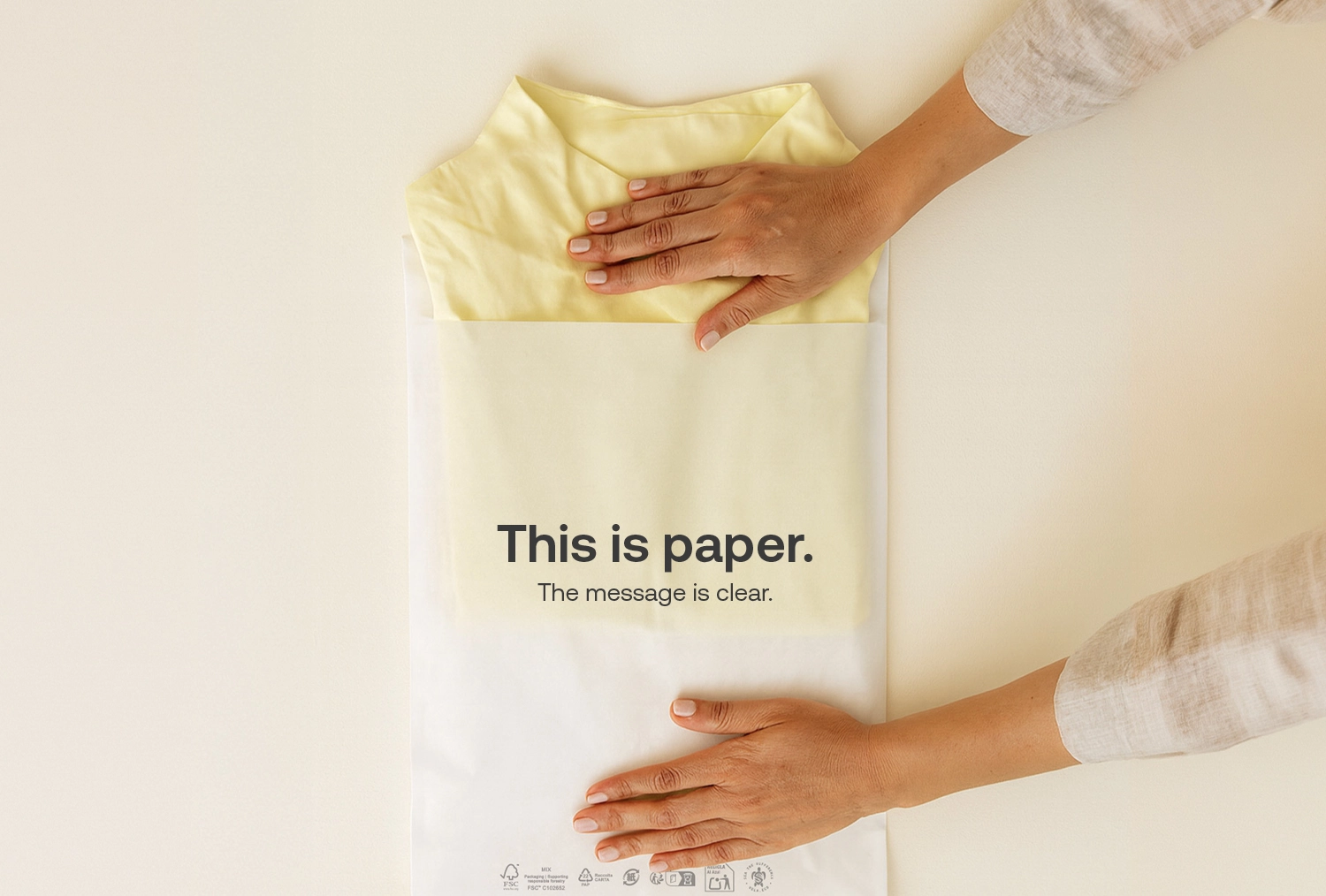
That recognition cuts both ways. Because people read the arrows as "recyclable", the SPC advises brands not to use them to signal recycled content. On a paper transport bag, the instruction that matches how people act is short: it says the bag is paper and that it goes in the paper recycling.
Since 27 September 2026, new EU rules implementing Directive (EU) 2024/825 have restricted generic environmental claims such as "eco-friendly" or "sustainable" across the EU unless a company can show recognised excellent environmental performance (European Commission Q&A). The Commission's guidance also notes that visual cues such as leaves and green colour schemes can count as claims. The UK CMA Green Claims Code and the US FTC Green Guides point the same way.
The research and the regulation arrive at the same place from different directions. Consumers respond to specific, actionable statements, and specific statements are the ones a brand can defend.
A clear claim only holds if the infrastructure behind it works. In the US, 61% to 65% of paper and 70% to 75% of cardboard available for recovery was recycled in 2025, according to the American Forest & Paper Association. Those are national figures for paper in general, not for any one product, but they show the system a paper bag enters when a customer puts it in the recycling at home.
Compostable packaging depends on conditions most households don't have. In SPC research on home composting, respondents who put certified home compostable packaging in their own compost said only about a third broke down as expected, and 18% said it didn't break down at all (BioCycle, May 2026). Those are self-reported results, but they match what the label has to promise and what the customer can actually do.
No material is right for every use. Sourcing, performance, transport and local collection all shape the answer, which is why the claim on the pack should describe the specific product, not the category.
Packaging communicates more than what is printed on it. The material itself shapes how customers experience a product, from the moment they receive an order to the moment they dispose of its packaging.
In a study commissioned by Seaman Paper and conducted by Quad in January 2026, 79% of participants preferred paper packaging over plastic. This preference is consistent with findings from a Michigan State University study, where 71% of respondents preferred paper packaging even without branding.
Broader consumer research reinforces the importance of packaging choices. A 2025 Amcor study found that 72% of consumers considered paper-based packaging claims persuasive, while McKinsey reported that 77% identified recyclability as the most important sustainability factor in packaging.
For apparel brands, these findings highlight an opportunity beyond replacing one material with another. Packaging is part of the customer experience, and the materials brands choose can influence how their products and environmental commitments are perceived.
When material choice, functionality and clear communication work together, packaging can become a meaningful extension of the brand experience.
For brands, the research points to a simple conclusion: effective packaging communication starts with clarity, not complexity.
Consumers should be able to understand what a package is made from, what its environmental claims mean and how to dispose of it correctly. Achieving this requires brands to consider not only the materials they choose, but also how they communicate their properties.
A few principles can help guide that process:
Keep it simple. Use familiar language and avoid technical terminology that may confuse consumers.
Be specific. Focus on clear, verifiable claims about the packaging rather than broad environmental promises.
Make it actionable. Where appropriate, provide practical disposal instructions that reflect the packaging’s characteristics and local recycling systems.
Support your claims. Ensure environmental statements are backed by relevant evidence, testing or recognised certifications.
Think beyond the packaging. Use websites and other communication channels to provide additional context without overwhelming the customer.
As consumer expectations and environmental regulations evolve, clarity and transparency are becoming increasingly important. For brands, the challenge is to communicate packaging choices in a way that is both meaningful to customers and supported by evidence.
Ultimately, good packaging communication isn’t about saying more. It’s about helping people understand what matters.
- Sustainable Packaging Coalition, recycled content consumer research, reported in Trellis, "Recycled content has a messaging problem, and an opportunity"
- SB+CO, Lost in Translation: the sustainability language gap and how to fix it (2026)
- GreenBlue, Findings from the first round of consumer testing the How2Recycle label refresh, 20 August 2024
- GreenBlue, Findings from the second round of consumer testing the How2Recycle label refresh, 17 September 2024
- BioCycle, Home compostable packaging: progress but not a silver bullet, 5 May 2026, reporting SPC research into home composting behaviours and packaging
- American Forest & Paper Association, Paper industry announces 2025 US paper recycling rates, 2026
- European Commission, Q&A on Directive (EU) 2024/825, via European Outdoor Group
- Quad for Seaman Paper, consumer packaging study, January 2026 (91 participants)
- Michigan State University, MSU Packaging Faculty Plays Vital Role in NSF Proposal to Advance Circular Packaging Economy.
- Amcor, Consumer Claims Report 2025.
- McKinsey & Company, Do US Consumers Care About Sustainable Packaging in 2025? (2025).
Bleiben Sie auf dem Laufenden mit Expertenwissen zu Verpackungen für die Bekleidungsindustrie, Nachhaltigkeit, Branchentrends, gesetzlichen Bestimmungen und Produktinnovationen.
SHARE THIS ARTICLE:


Lassen Sie uns darüber sprechen, wie Vela™ Sie bei Ihren Zielen unterstützen kann.


Füllen Sie das Formular aus und einer unserer Vertriebsmitarbeiter in Ihrer Region wird sich innerhalb von 72 Stunden bei Ihnen melden.

