.svg)



Packaging is entering a new phase.
With the introduction of the EU Packaging and Packaging Waste Regulation (PPWR), sustainability is no longer a narrative or a voluntary commitment. It is becoming a requirement — embedded into how packaging is designed, used, and evaluated across the entire European market. For brands, this is not just a regulatory update. It is a structural shift.
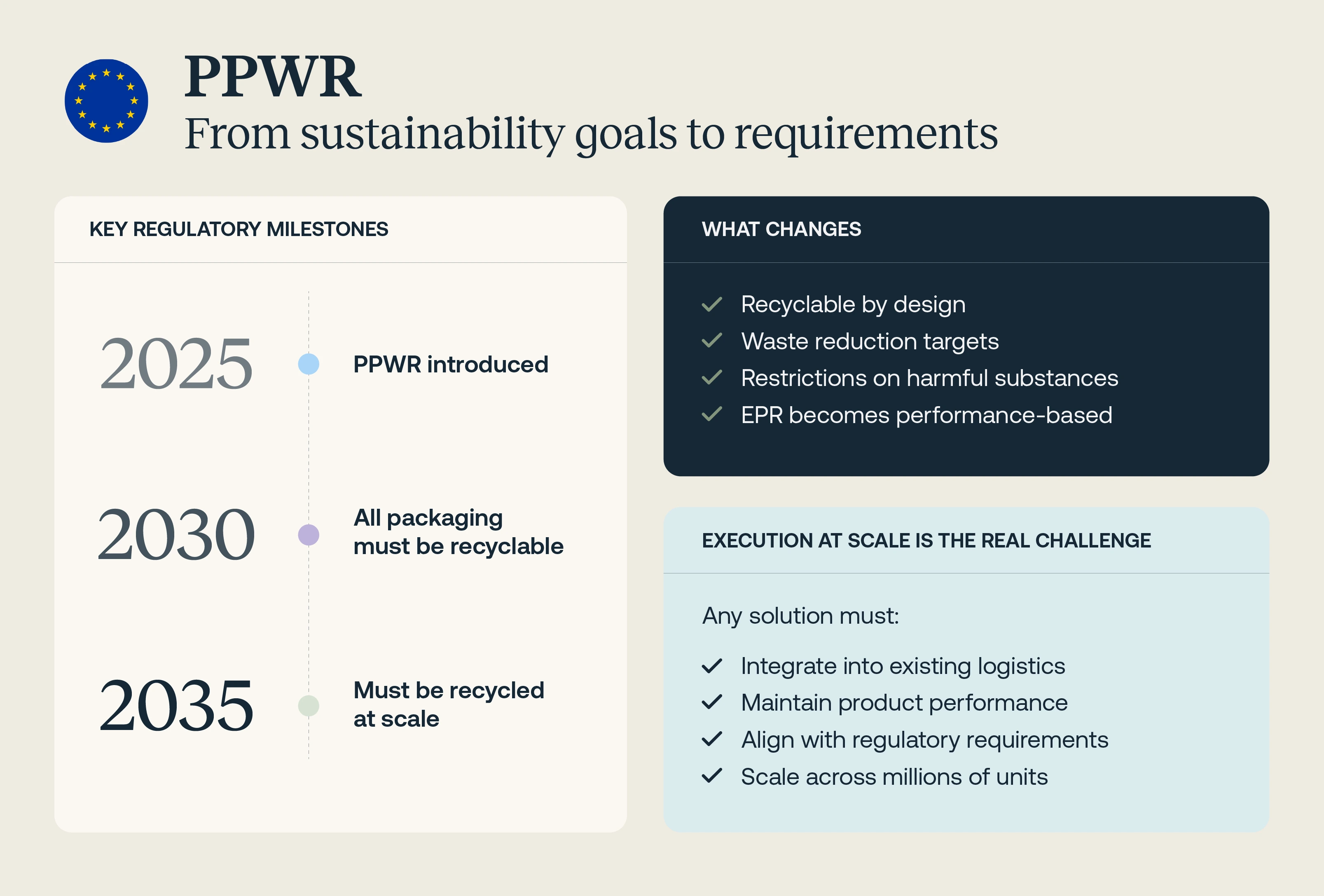
The PPWR is designed to reduce packaging waste and accelerate the transition to a circular economy across the EU. Published in 2025 and applicable to all packaging, including imports, it introduces a new baseline:
- Packaging must be recyclable by design and in practice
- Waste reduction targets will apply across categories
- Restrictions will limit the use of certain substances, including PFAS
- Minimum recycled content requirements will be introduced for plastic packaging
- Extended Producer Responsibility (EPR) schemes will evolve to reward more sustainable solutions
By 2030, all packaging placed on the EU market will need to be designed to be recyclable. By 2035, this requirement goes further, demanding proof that packaging is effectively recycled at scale within real systems. This marks a critical shift: recyclability is no longer a theoretical concept, but something that must work in practice, within existing collection and recycling infrastructures.
As regulation evolves, packaging decisions become more strategic. Materials are no longer evaluated only on cost or performance, but on how they behave across the entire lifecycle, from logistics to end-of-life.
Packaging sits at the intersection of:
- Product protection
- Operational efficiency
- Consumer use
- Recycling infrastructure
At the same time, Extended Producer Responsibility (EPR) schemes are introducing a new economic dynamic. Fees will increasingly be linked to the recyclability performance of packaging, meaning that more recyclable solutions will benefit from lower costs, while less recyclable ones will become more expensive. As a result, sustainability is no longer just a responsibility. It becomes a measurable operational lever with direct financial implications.
For most brands, the challenge is not defining sustainability goals. It is implementing them across complex, global supply chains, without disrupting operations. Packaging is one of the most immediate levers available, but also one of the most complex to change.
Any solution must:
- integrate into existing logistics
- maintain product performance
- align with regulatory requirements
- scale across millions of units
Because change only matters if it works in the real world.
PPWR brings clarity to the direction the industry is taking. It aligns regulation, infrastructure, and market expectations around a shared goal: packaging that performs within a circular system. For brands, this is not just a constraint, but an opportunity to rethink materials, simplify systems, and better align sustainability with operations. The shift is already underway.
The question is no longer whether packaging needs to change, but how quickly brands can adapt, and how effectively they can translate that change into performance.
In this new context, packaging is no longer a secondary decision, but a strategic one. Today, performance and sustainability can no longer be considered separately, they are increasingly part of the same decision.
For brands navigating this shift, the challenge is not only understanding the direction, but finding solutions that can be implemented in practice. Learn how Vela supports this transition.
• European Commission – Packaging and Packaging Waste
• European Commission – Circular Economy Action Plan
• OECD – Extended Producer Responsibility
• European Chemicals Agency (ECHA) – PFAS
Stay informed with expert insights on apparel packaging, sustainability, industry trends, regulations and product innovation.
SHARE THIS ARTICLE:


Let’s talk about how Vela™ can support your goals.


Fill out the form and one of our sales representatives in your region will get back to you within 72 hours.