.svg)


For years, plastic polybags have been the default choice for packaging across many industries, especially in fashion and apparel. Low cost, easy to source, and operationally reliable. Today, that assumption is starting to break. Beyond the well known environmental concerns, brands are now facing a different kind of challenge. Plastic is becoming harder to plan around.
The conversation around plastic has long been driven by sustainability. What is changing now is the nature of the problem.
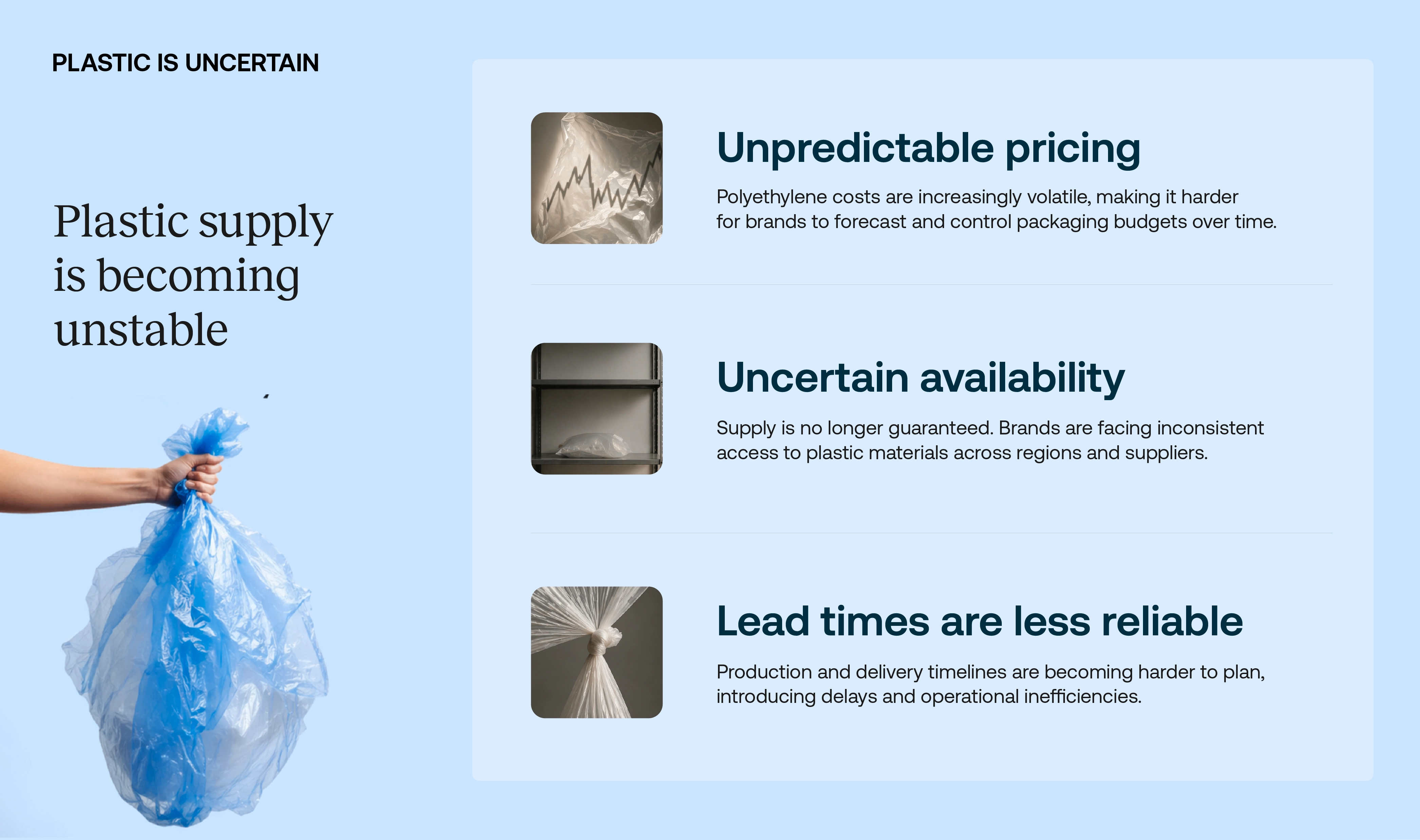
Brands and suppliers are increasingly facing unpredictable pricing, uncertain availability, and longer, less reliable lead times. In some cases, purchasing polyethylene now requires open price agreements, with limited visibility on both cost and delivery timing. What was once a cost consideration is becoming a supply risk.
Recent global dynamics are putting pressure on the plastics value chain. Geopolitical tensions and instability in key oil producing regions, as highlighted by CNN, are directly impacting petrochemical production, which is the foundation of materials like polyethylene. At the same time, market intelligence platforms such as ICIS and Platts report increasing volatility in polymer markets, particularly in Europe.
The result is a system where:
- prices fluctuate more frequently
- supply is less predictable
- procurement decisions carry higher risk
This situation is not unfolding in the same way across all markets, and that is part of what makes it more complex to manage.
While some regions and brands are not yet experiencing significant disruption, others, particularly in parts of Europe, are already facing increasing pressure in terms of availability, pricing, and lead times. This uneven distribution means that global brands can no longer rely on a single, consistent sourcing strategy.
Instead, they are required to manage different realities across regions, anticipate potential disruptions rather than simply react to them, and make decisions that are increasingly time sensitive. What was once a relatively stable and predictable system is becoming more dynamic, and more difficult to control.
Packaging has traditionally been treated as a stable, almost invisible component of operations, rarely questioned unless there is a cost pressure or a sustainability initiative. What is changing now is the level of exposure.
When pricing becomes volatile and availability less reliable, packaging is no longer a passive element. It starts to influence timelines, supply chain decisions, and the ability to deliver products on schedule. What was once a straightforward procurement decision becomes a variable that requires active management.
This shift forces brands to rethink their priorities, moving beyond cost efficiency toward solutions that offer consistency, control, and predictability over time, shifting the focus from short term optimization to long term resilience. In a market where uncertainty is increasing, the ability to rely on stable inputs becomes a strategic advantage, helping brands maintain continuity, reduce risk, and respond more effectively to changing conditions.
As pressure on plastic increases, the conversation is shifting. It is no longer just about cost, but about control, consistency, and long-term viability.
Paper packaging offers a more reliable alternative, with established supply chains, clearer end-of-life pathways, and easier integration. More importantly, it delivers something plastic cannot: a stronger connection between material, message, and brand perception. Based on independent behavioural research conducted with Quad, paper packaging does more than replace plastic. It improves how brands are seen, remembered, and experienced:
- Stronger sustainability perception
- Higher consumer attention
- Better message recall over time
- Premium and luxury brand association
- Higher likelihood of being recycled
At the same time, regulatory pressure in Europe, including PPWR, is reinforcing the shift toward more circular materials. As new requirements around recyclability, waste reduction, and material transparency begin to take shape, brands are being pushed to reassess their packaging choices not only from an environmental perspective, but also from a compliance and long term viability standpoint.

Brands have been testing paper for years. What is changing now is the urgency. As supply conditions become less predictable, the shift is moving from experimentation to implementation. At the same time, material choices are shaping how brands are perceived, with paper packaging enhancing both brand experience and sustainability perception.
At Vela, we have been working on paper based packaging solutions designed specifically for the needs of modern brands, balancing performance, transparency, and scalability.
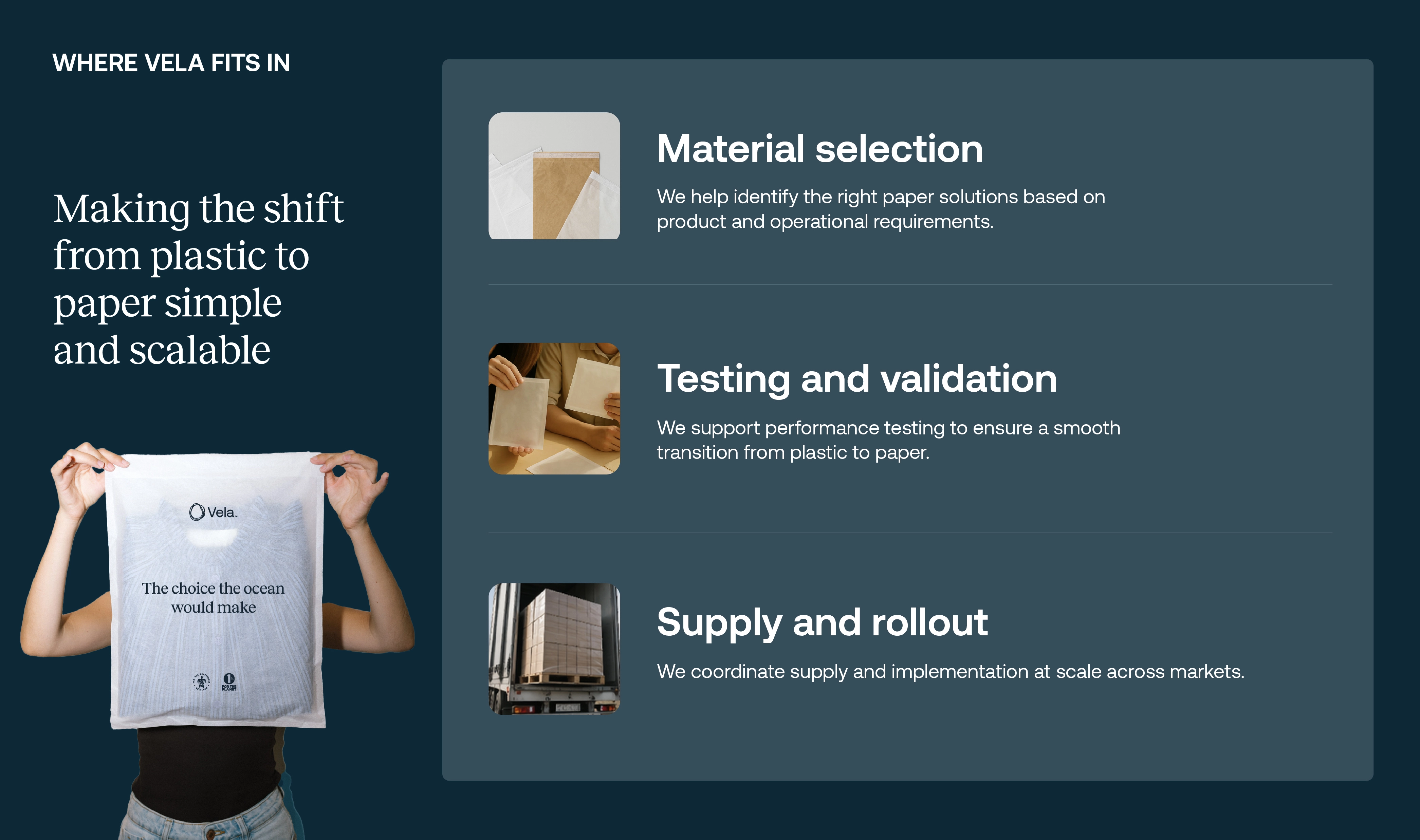
Our approach focuses on making the transition from plastic to paper as seamless as possible, supporting brands through:
- material selection
- testing and validation
- supply and rollout
We also contribute to broader industry frameworks such as the CEPI recyclability framework, helping ensure solutions are aligned with real world recycling systems. As brands face increasing pressure around availability, pricing volatility, and supply chain reliability, this becomes critical.
Vela is designed to address these challenges directly. By relying on established paper supply chains, we offer a more stable and predictable sourcing model, reducing exposure to the kind of uncertainty currently affecting plastic. At the same time, our materials are engineered to meet the functional requirements of garment packaging, ensuring that performance is not compromised when transitioning away from polybags.
Plastic polybags are still widely used today. But their role as a stable default is being challenged, not only by environmental concerns but by market dynamics and supply uncertainty. In this context, the brands that act early will have more control, more flexibility, and fewer disruptions. To explore how to switch to a more stable packaging solution, discover Vela’s onboarding process.
- CNN – Plastic cost and geopolitical tensions, 2026
Stay informed with expert insights on apparel packaging, sustainability, industry trends, regulations and product innovation.
SHARE THIS ARTICLE:


Let’s talk about how Vela™ can support your goals.


Fill out the form and one of our sales representatives in your region will get back to you within 72 hours.