.svg)



Les pochettes en plastique restent le format d'emballage dominant dans l'industrie de la mode, avec un nombre estimé de 180 milliards d'unités utilisées chaque année pour protéger et transporter les articles d'habillement. La plupart de ces pochettes sont conçus pour un usage unique et ont de faibles taux de recyclage.
Alors que les marques de mode sont confrontées à une pression réglementaire croissante et à des attentes grandissantes des consommateurs en matière de durabilité, beaucoup explorent des alternatives aux emballages en plastique.
Vela™ a été créé pour aider les marques de mode à remplacer les pochettes en plastique par du papier, tout en maintenant la protection des produits et en améliorant l'expérience client. Depuis son lancement, plus de 300 millions de pochettes en papier Vela sont entrés sur le marché, soutenant les marques dans leur transition pour abandonner le plastique.
Mais une question importante demeurait : comment les consommateurs perçoivent-ils réellement les emballages en papier par rapport au plastique, et le matériau d'emballage influence-t-il la perception de la marque ?
Pour mieux comprendre ces dynamiques, Vela s'est associé à L'équipe d'insights marketing accélérés de Quad pour mener une recherche comportementale indépendante axée sur la perception de l'emballage pendant l'expérience de déballage.

L'étude a simulé une expérience réaliste de livraison de vêtements à domicile. Des participants de la Génération Z et de la Génération Y ont reçu un t-shirt emballé dans l'un des trois formats suivants :
Les chercheurs ont utilisé plusieurs outils de mesure comportementale :
Cette approche a permis aux chercheurs de mesurer à la fois les préférences déclarées et les réponses comportementales réelles aux matériaux d'emballage.

L'étude révèle un schéma clair et cohérent : le matériau d'emballage a un impact direct sur la façon dont les consommateurs perçoivent, interagissent avec et évaluent une marque.
À toutes les étapes de l'expérience de déballage, l'emballage en papier a surpassé le plastique, non seulement en termes de perception de la durabilité, mais aussi en termes d'attention, d'engagement et d'association à la marque.
79 % des consommateurs ont préféré l'emballage en papier au plastique, confirmant un changement fort et croissant dans les attentes des consommateurs.
Kes enseignements clés de l'étude comprennent :
- L'emballage en papier augmente l'engagement, générant jusqu'à 60 % d'attention visuelle supplémentaire lors du déballage
La perception de la durabilité est nettement plus élevée, le papier offrant une perception de durabilité jusqu'à deux fois plus forte que le plastique.
L'association à une marque éco-responsable s'améliore, 77 % des participants associant l'emballage en papier à des marques responsables.
La perception haut de gamme est renforcée, les formats en papier étant plus fréquemment associés à des marques plus haut de gamme et plus soucieuses.
Ces résultats démontrent que l'emballage n'est plus un élément neutre. Il est une partie visible et influente de l'expérience de marque.

L'analyse par suivi oculaire a montré que le choix du matériau affecte considérablement la durée pendant laquelle les consommateurs interagissent avec l'emballage lors du déballage.
Attention visuelle totale moyenne sur l'emballage :
Concrètement, l'emballage en papier a généré jusqu'à 60 % d'engagement en plus que l'emballage plastique traditionnel. Cette fenêtre d'attention prolongée transforme l'emballage d'un élément fonctionnel en une opportunité de narration et d'interaction avec la marque.

Le choix du matériau a fortement influencé la façon dont les participants percevaient la responsabilité environnementale de la marque.
Dans l'étude :
Les pochettes en plastique ont été systématiquement perçus comme l'option la moins respectueuse de l'environnement.
Les consommateurs recherchaient activement des indices de durabilité lorsqu'ils interagissaient avec les emballages en papier. L'analyse par suivi oculaire a montré qu'une grande partie de l'attention visuelle était dirigée vers les messages sur la durabilité et les icônes de matériaux imprimés sur l'emballage.
Les principales conclusions sont les suivantes :
Ces conclusions suggèrent que lorsque les informations sur la durabilité sont clairement communiquées, les consommateurs non seulement les remarquent, mais s'en souviennent.
Au-delà de la durabilité, l'étude révèle un impact clair et mesurable sur la perception des marques. Le matériau d'emballage façonne directement cette perception, influençant la manière dont les consommateurs interprètent la qualité, la responsabilité et le positionnement de la marque.
Les participants ont constamment décrit les emballages en papier comme plus réfléchis, plus haut de gamme et mieux alignés avec les marques responsables.
Globalement :
- 79 % des consommateurs préfèrent les emballages en papier au plastique
- Les emballages en papier offrent une perception de durabilité jusqu'à 2 fois supérieure
- 77 % associent les emballages en papier à une image de marque écologique (contre 34 % pour le plastique)
Ces résultats montrent que le choix du matériau n'est pas seulement une décision fonctionnelle. C'est un levier stratégique pour améliorer la perception de la durabilité et renforcer le positionnement des marques haut de gamme.

L'étude souligne comment le matériau d'emballage peut façonner à la fois la perception et le comportement. Passer du plastique au papier fait plus que réduire l'impact environnemental ; cela peut également renforcer la façon dont les consommateurs vivent et interprètent la marque.
Pour les marques de mode, les emballages en papier peuvent offrir plusieurs avantages stratégiques :
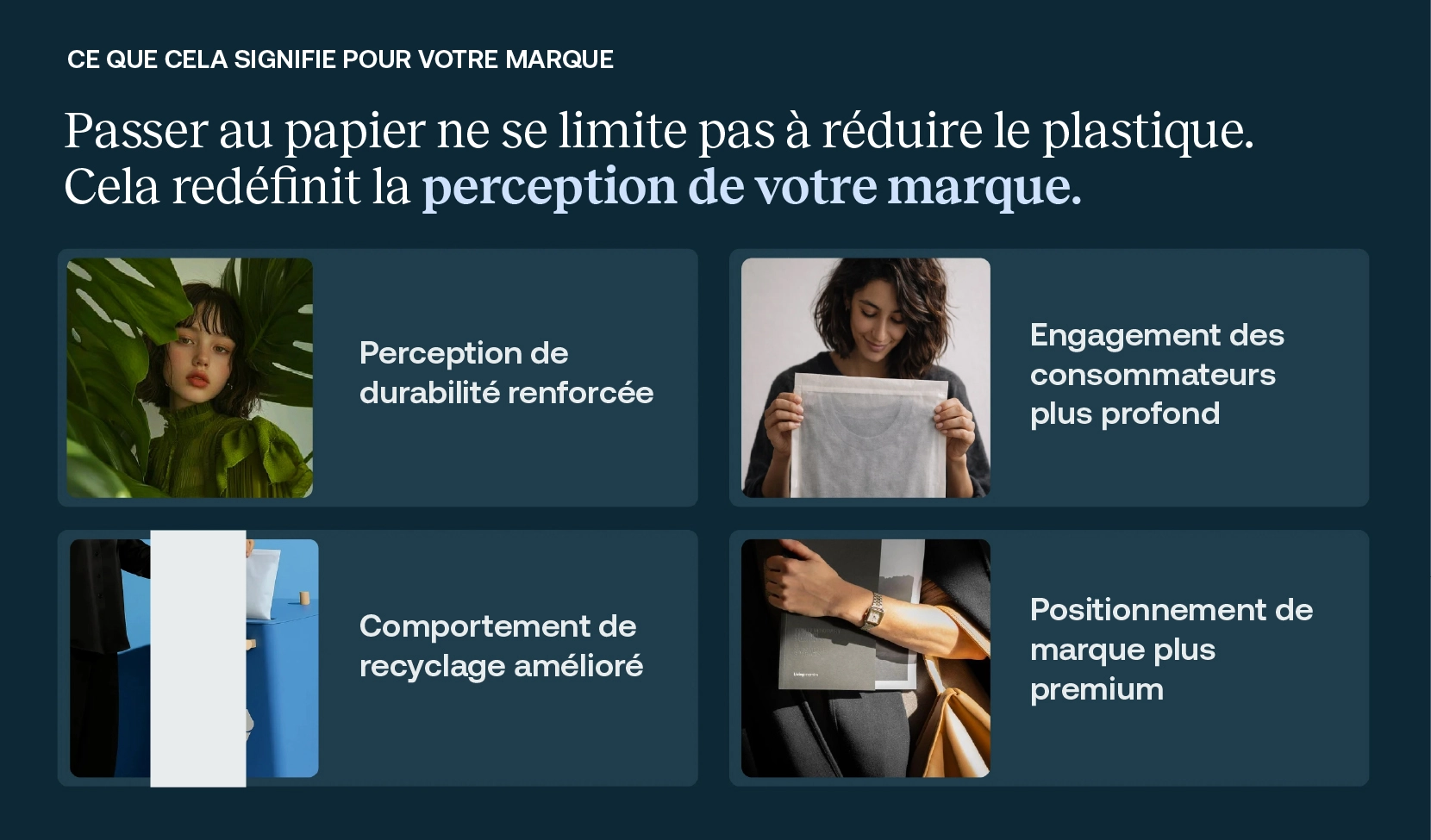
Alors que les attentes en matière de durabilité continuent d'évoluer, l'emballage n'est plus seulement une décision opérationnelle. Il est devenu une partie intégrante de l'expérience de marque.
Des exemples de marques ayant déjà opéré cette transition sont visibles dans les études de cas Vela, ainsi que plus d'informations sur la plateforme d'emballage Vela et son approche en matière d' emballage responsable.
Découvrez comment les marques remplacent les pochettes en plastique par Vela
• Fashion for Good & Boston Consulting Group – Le problème du plastique dans la mode (2019)
• Quad – Accelerated Marketing Insights (Étude comportementale Seaman Paper, 2026)
Téléchargez l'étude complète et découvrez comment le choix des matériaux influence la perception, l'engagement et la valeur de la marque.
SHARE THIS ARTICLE:


Parlons de la façon dont Vela™ peut soutenir vos objectifs.


Remplissez le formulaire et l'un de nos représentants commerciaux de votre région vous contactera dans les 72 heures.