


On 28 October 2026, a dive team from the University of Sassari went back to the Posidonia oceanica restoration site at Cala di Volpe, in north-east Sardinia, for the first check on the area planted in May. Their report, shared with Vela by One Ocean Foundation in November, puts cutting survival at 88%, with no difference between the three planted fields.
This is our third update on the Blue Forest project. Restoring the Blue Forest: From Contribution to Impact explained why Vela funds marine restoration through Sea the Difference. New Shoots, Real Data covered the first year of work with coconut-fibre biomats. This one covers the next phase, which Vela's contribution helped fund.
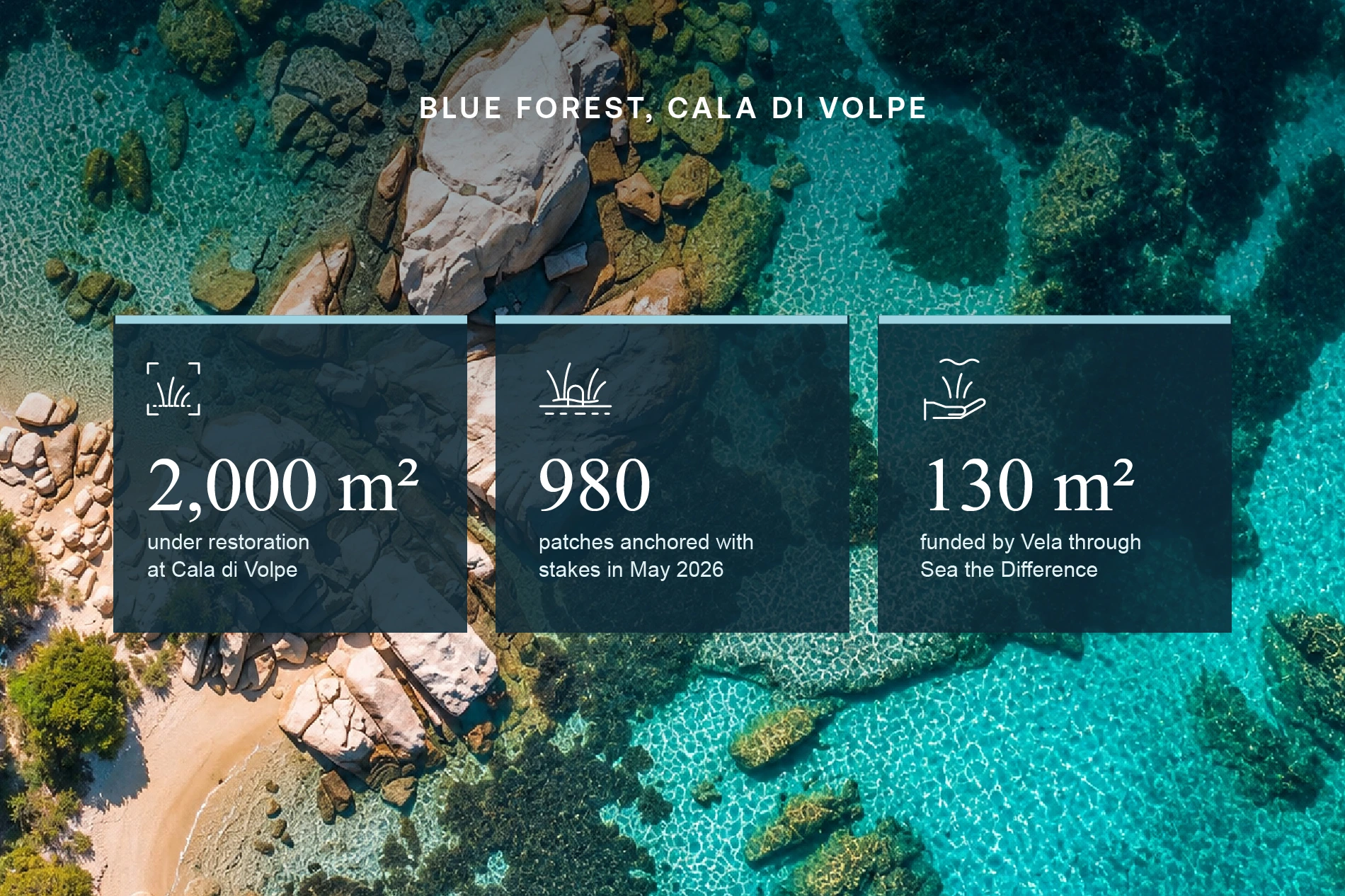
The project started in 2025 with two transplants on coconut-fibre biomats, in May and November, covering 1,000 m² with 50 mats. Results from the December 2025 and March 2026 monitoring campaigns gave the team enough confidence to expand the site in May 2026, using a different technique.
This time the cuttings were fixed straight onto the dead matte, the compact layer of old Posidonia rhizomes left behind where a meadow once grew. Divers used U-shaped galvanised steel stakes, 15 cm long, one per cutting (two for particularly long ones). Each patch holds 10 cuttings carrying 2 to 7 shoots each, and patches were placed one per square metre in the gaps between the biomats.
In total the team planted 980 patches at a depth of 10 to 11 metres, close to the Cala di Volpe mooring field. That added about 1,000 m², bringing the restored area to about 2,000 m². Vela's contribution covers 130 m² of the May expansion.
The mooring field is closed to underwater work during the summer season, so October was the first visit since planting. Divers checked the stakes visually across the three fields and counted cuttings and shoots on 120 randomly selected patches out of the 980 planted.
On average, each patch still held 8.8 of its original 10 cuttings, which is where the 88% survival figure comes from. Shoot numbers tell a similar story: 25.6 shoots per patch in October, against 29.1 at planting in May. The stakes are holding well overall. In a few patches some had lifted slightly from the seabed, and cuttings were lost there.
The researchers describe the site as in good condition and the results as in line with the scientific literature (Mancini et al., 2021; De Luca et al., 2024). In their view, the data so far supports planning further expansions of the restoration area.
It's tempting to set 88% next to the biomat results we reported in July, but the two aren't directly comparable yet. They were planted at different times of year and checked at different intervals after planting. The February monitoring will give a clearer picture of how the stakes perform over a winter.
Posidonia oceanica grows only in the Mediterranean, and it grows slowly: its rhizomes extend by about 1 to 6 cm a year (Marbà et al., 1996). A basin-wide mapping study estimated that meadows had regressed by 34% over the previous 50 years (Telesca et al., 2015). With growth that slow, a lost meadow doesn't come back on its own in any useful timeframe, which is why restoration projects plant cuttings rather than wait.
It's also why the first monitoring rounds focus on whether the cuttings stay anchored and alive, rather than on how far the meadow has spread. Spread is measured in years.
Blue Forest is led by One Ocean Foundation, with the International School for Scientific Diving (ISSD) running restoration and diving operations and the University of Sassari leading the monitoring. The diving, the planting and the science are theirs. Vela funds part of the project through Sea the Difference, its ocean programme, as a member of 1% for the Planet, and shares the results here as they come in, including the ones that don't go to plan.
The next monitoring campaign is planned for February 2027, weather permitting. The team will check the stakes again, measure survival and start looking at the marine life returning to the restored area.
A Posidonia meadow grows a few centimetres a year, so progress at Cala di Volpe is counted in seasons, not weeks. What the divers are building, patch by patch, is a meadow that will still be growing long after the last monitoring report has been filed.
See the projects Vela funds through Sea the Difference
- University of Sassari, Department of Chemical, Physical, Mathematical and Natural Sciences. First report: Monitoring of the stake transplant at the Cala di Volpe restoration site, October 2026 monitoring campaign. 2 November 2026. Prepared for One Ocean Foundation.
- De Luca, M. et al. (2024). Restoration of Posidonia oceanica meadow using cuttings from an area impacted by harbor extension project. Journal of Marine Science and Engineering, 13(1), 3.
- Mancini, G. et al. (2021). An experimental investigation aimed at validating a seagrass restoration protocol based on transplantation. Biological Conservation, 264, 109397.
- Marine Ecology Progress Series, 137, 203–213.
- Telesca, L. et al. (2015). Seagrass meadows (Posidonia oceanica) distribution and trajectories of change. Scientific Reports, 5, 12505. https://www.nature.com/articles/srep12505
Stay informed with expert insights on apparel packaging, sustainability, industry trends, regulations and product innovation.
SHARE THIS ARTICLE:


Let’s talk about how Vela™ can support your goals.

Fill out the form and one of our sales representatives in your region will get back to you within 72 hours.

