.svg)


Off the coast of Sardinia, inside an 80 hectare mooring buoy field in the Cala di Volpe Bay, something quiet but consequential has been happening beneath the surface. In February 2025, the Blue Forest project, led by One Ocean Foundation in partnership with the University of Sassari, began what would become one of the most ambitious Posidonia oceanica reforestation efforts in the Mediterranean Sea. A year on, the first monitoring data is in, and it tells a story of real, measurable regrowth.
We first wrote about Blue Forest when the Sardinia expansion launched, and followed up with a look at how the project fits into Vela's broader environmental commitments. Since then, the project has moved from mapping and planning to transplantation, monitoring, and finally results.
Before a single cutting went into the seabed, the team spent months understanding it. Working with Geomars, a University of Sassari spinoff, researchers combined Side Scan Sonar, ROV surveys, and SCUBA diving to build a high resolution biocenotic map of the bay, distinguishing living meadow from dead matte and identifying exactly where restoration could take hold.
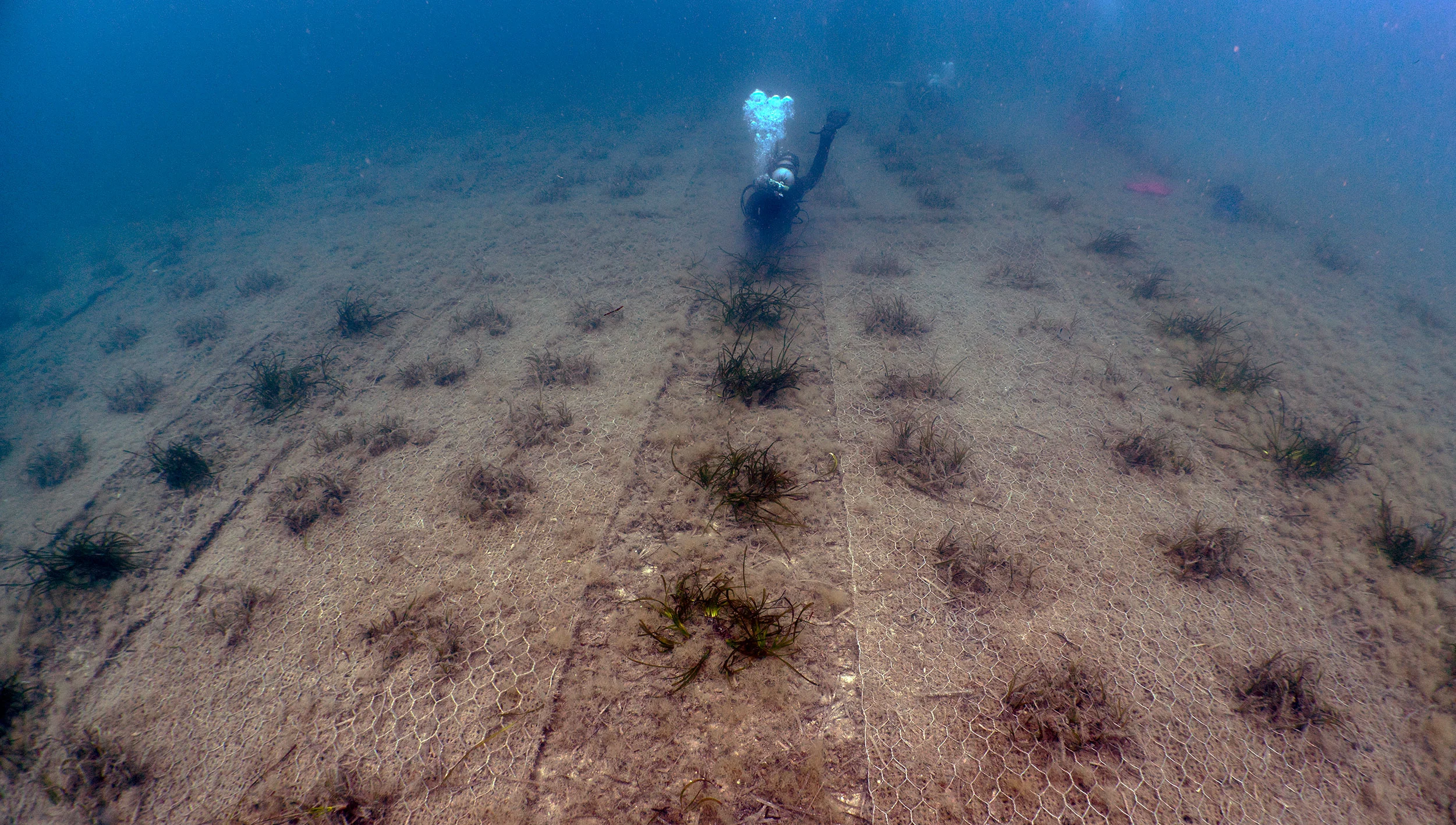
That precision shaped the approach. In April 2025, scientific divers began installing coconut fiber biomats reinforced with metal mesh, each seeded with around 20 Posidonia oceanica cuttings per square meter. All cuttings were collected exclusively from naturally detached plants; nothing was taken from healthy, living meadow. Three intervention sites were chosen deliberately: one on bare dead matte, one in a fragmented patch to reconnect isolated sections, and one at the edge of a healthy meadow to track natural expansion. The team also experimented with a newer technique, germinating seedlings from beached Posidonia fruit collected after a rare winter flowering event, to broaden the science behind the restoration, not just its scale.
Posidonia grows slowly and is notoriously difficult to restore, which is what makes the early numbers from Cala di Volpe notable:
The first transplantation campaign, carried out in May 2025, reached an 83% survival rate by September and 91% by December, well above what's typical for seagrass restoration at this stage. Encouraged by the results, the team expanded the site in November 2025. A second campaign, monitored that December, recorded a 100% survival rate. The restored area now totals approximately 2,000 m².
Survival is only part of the picture. Between September and December, researchers recorded an increase in shoot density, a sign the plants have moved past initial establishment and into active vegetative growth. Biomass and patch size are expanding too. And the biomats themselves are being naturally colonized by algae and small marine organisms, meaning the transplant structures are starting to disappear into the ecosystem rather than sit on top of it.
Alongside the transplantation work, the University of Sassari team is running parallel research: comparing biodiversity in restored versus healthy meadows using ecoacoustics and AI based species identification, and building a baseline to measure how much carbon the transplanted meadow is capturing, work that could, in time, support formal carbon credit certification.
Posidonia oceanica isn't just a seagrass. It's often called the lungs of the Mediterranean: it produces oxygen, stabilizes the seabed, shelters hundreds of marine species, and stores carbon at rates comparable to some of the densest forests on land. More than 30% of it has already been lost to anchoring, trawling, and coastal pressure. Restoring it back is slow, technical work, and results like these, quantified, monitored, and independently verified by university researchers, are still the exception rather than the rule in marine restoration.
This is also where our own role stays deliberately modest. Through Sea the Difference and our 1% for the Planet commitment, Vela™ contributes to the network of organizations funding this work. We're not the ones in the water; the credit belongs to the scientists, divers, and researchers doing the restoration. What we can do is point to what that support makes possible, and be transparent about what's proven and what's still in progress.
Because there's more to come: a further reforestation phase at Cala di Volpe was completed in spring 2026, with monitoring beginning after summer. We'll share those results as soon as they're in.
If you want to understand how a packaging decision connects to work like this, get in touch, or read more about Sea the Difference.
Stay informed with expert insights on apparel packaging, sustainability, industry trends, regulations and product innovation.
SHARE THIS ARTICLE:


Let’s talk about how Vela™ can support your goals.

Fill out the form and one of our sales representatives in your region will get back to you within 72 hours.