.svg)


Through Sea the Difference and its commitment to 1%for the Planet, Vela contributes a portion of its revenue to environmental initiatives focused on ocean protection and restoration.
This is not a standalone program, but a structural part of how the brand approaches sustainability. Rather than positioning impact as an external activity, Vela integrates contribution into its operating model, linking each bag to broader environmental efforts.
Among the initiatives supported through this framework is the BlueForest project, led by OneOcean Foundation. The project focuses on restoring seagrass ecosystems in the Mediterranean through science based marine reforestation.
Over 30% of Posidonia oceanica meadows in the Mediterranean Sea have already disappeared.
Despite being a protected species, it remains severely threatened by coastal human activities such as anchoring and bottom trawling, which cause irreversible damage and disrupt the balance of entire marine ecosystems.
The Blue Forest project is a marine restoration initiative aimed at regenerating Posidonia oceanica meadows, one of the most important ecosystems in the Mediterranean Sea.
Often referred to as the blue forests, these seagrass meadows play a critical role in the health of marine environments. They capture and store significant amounts of carbon, support biodiversity by providing habitat for marine species, protect coastlines from erosion, and contribute to improving water quality.
Unlike many environmental initiatives, this work happens underwater and requires a high level of scientific precision. It involves the transplantation of seagrass, continuous monitoring, and long term ecosystem management to ensure that restored areas can survive and regenerate over time.
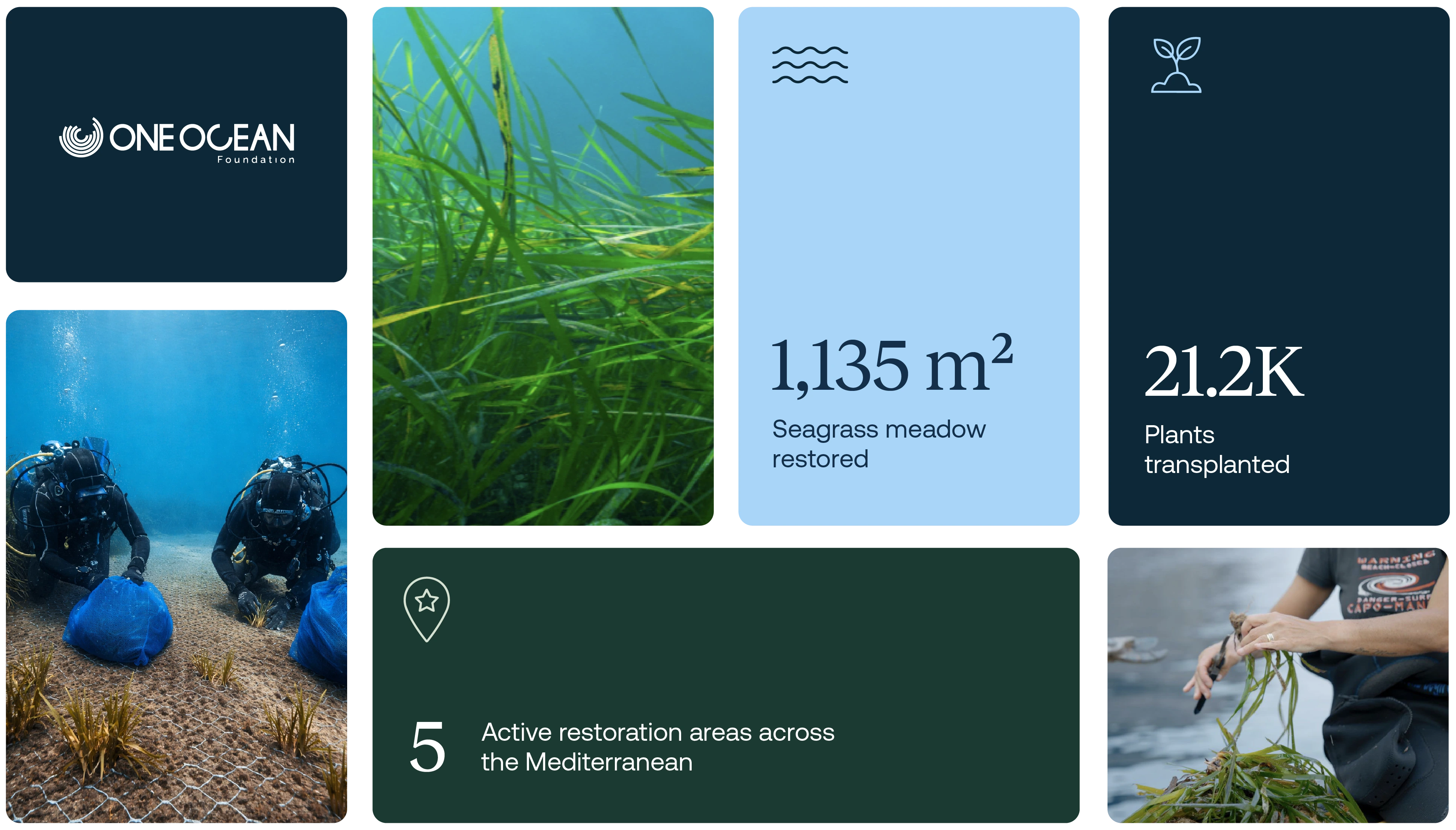
What makes the Blue Forest project particularly relevant is its ability to translate environmental intent into measurable outcomes. The initiative, led by One Ocean Foundation incollaboration with research institutions, has already generated tangibleresults across multiple restoration sites:
- more than 21,000 plants transplanted
- over 1,100 square meters of seagrass meadow restored
- 5 active restoration areas across the Mediterranean
- 2 PhD scholarships funded
- ongoing scientific research supported through academic partnerships
These results are the outcome of a collective effort involving scientists, institutions, and organizations contributing through the 1% for the Planet network. Vela’s role is to supportthis system, contributing to its continuity rather than claiming ownership ofits outcomes.
Projects like Blue Forest reflecta broader shift in how environmental impact is understood. The conversation ismoving beyond reduction alone. It is increasingly focused on restoration, regeneration, and the long term functionality of natural systems.
Seagrass ecosystems are among themost efficient natural carbon sinks. Their degradation has direct implications for climate balance, biodiversity, and coastal stability. Supporting their restoration contributes to rebuilding ecological infrastructure that operates over time, often invisibly, but with significant long term effects. This is where environmental action becomes both measurable and systemic.
For Vela, contributing to BlueForest is part of a broader perspective that connects materials, operations,and ecosystems. Through Sea the Difference, packagingis linked to environmental initiatives beyond the product itself. Through 1% for the Planet, that contribution is structured and continuous.
This approach does not aim toposition packaging as a solution on its own. Instead, it acknowledges thatpackaging exists within a wider system, one that depends on functioning ecosystems and long term environmental balance.
Sustainability is no longer defined only by what is reduced. It is increasingly defined by what isrestored, and by how consistently that restoration is supported over time. In this context, contributing to initiatives like this extends the role of packaging beyond the product, supporting the natural systems that make circularity possible in the first place.
Stay informed with expert insights on apparel packaging, sustainability, industry trends, regulations and product innovation.
SHARE THIS ARTICLE:


Let’s talk about how Vela™ can support your goals.

Fill out the form and one of our sales representatives in your region will get back to you within 72 hours.