.svg)



In 2019, some of the world’s largest fashion groups and brands, collectively representing around a third of the global fashion industry, made a public commitment. Under the Fashion Pact's Oceans pillar, they set a deadline: eliminate problematic and unnecessary plastic packaging in B2C by 2025, and cut recycled-content gaps at the same time. Polybags — the thin-film plastic sleeves wrapping nearly every garment moving through the supply chain — were named explicitly as a priority target.
That deadline has now passed. In January 2026, the Fashion Pact published its Reporting on Targets 2025, and the verdict is unusually candid for an industry report: “On plastics, change has not happened at the necessary level.”
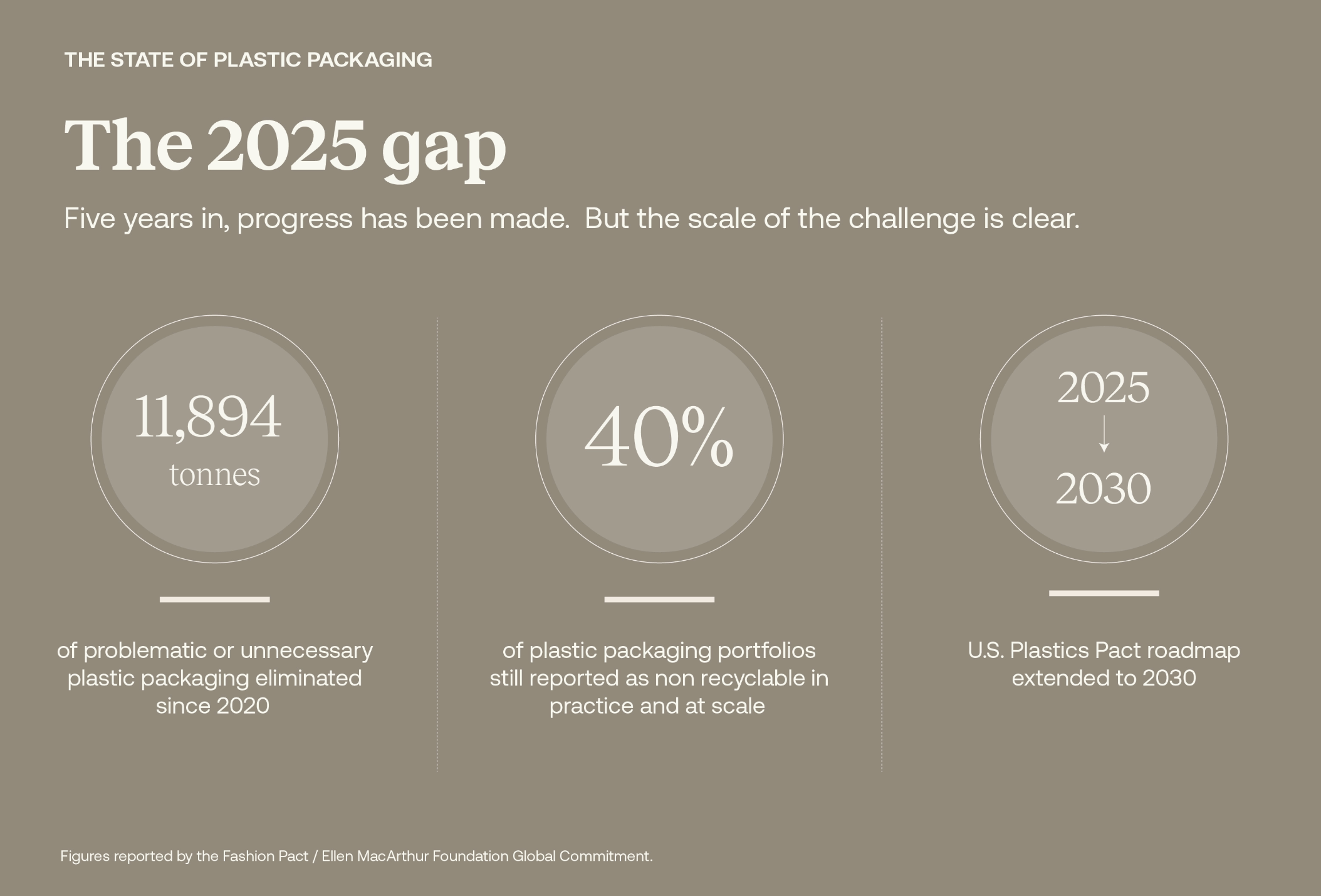
Since 2020, apparel signatories to the Ellen MacArthur Foundation’s Global Commitment have collectively eliminated 11,894 tonnes of problematic or unnecessary plastic packaging. That is the entire five-year output of a coalition representing roughly 200 brands and a third of the global fashion industry. Roughly 40% of member packaging portfolios remain non-recyclable in practice at scale.
Progress was never uniform. The Fashion Pact's own reporting shows 60% of signatory brands have eliminated plastic from retail bags. In hangers and B2B transport bags, only 15% have managed elimination. The gap between “easy win” and “structural fix” is exactly where most plastic packaging commitments stall.
This isn't a fashion-specific problem. The U.S. Plastics Pact — convened, like the Fashion Pact's network, under the Ellen MacArthur Foundation — set four parallel targets for 2025: eliminate problematic materials, make all packaging reusable/recyclable/compostable, hit 50% recycling rates, and reach 30% recycled content. It missed every one. By 2024, only 29% of member companies had stopped selling any item on the problematic-materials list (against a 100% goal), recycled content sat at 14% (against 30%), and the group has now pushed its entire roadmap back to 2030.
Here is the detail that matters most for brands deciding whether to wait for an industry wide solution. The Fashion Pact’s January 2026 report is the final report based on its original 2019 Global Goals framework. As it moves into its next phase, the coalition is directing collective action toward areas where it believes it can deliver greater environmental impact.
Packaging remains a challenge, but it is no longer the focus of a dedicated Joint Action. The reasoning is clear. According to the Fashion Pact, packaging accounts for less than 2% of the textile industry’s greenhouse gas emissions, while raw materials and material production account for more than 90%. From a climate perspective, shifting resources toward higher impact areas is a defensible decision.
The implication for brands is equally clear. After completing its collective research on polybags, the Fashion Pact is prioritising other areas of intervention. Brands that remain exposed to plastic packaging risks, whether regulatory, reputational or customer facing, will increasingly need to address those challenges through their own packaging strategies.
Before shifting its focus, the Fashion Pact commissioned extensive research into alternatives to conventional plastic polybags. Its 2024 lifecycle assessment, developed with member brands and specialist partners, reached a clear but geographically specific conclusion.
For Europe and the United States, the study identified paper based packaging as the preferred option over plastic when considering both climate change and land use impacts. Packaging made from 100% recycled plastic emerged as the second best option. The study also highlighted that the right solution depends on regional infrastructure, energy systems and end of life conditions. China, for example, presented a different set of challenges and potential pathways.
The significance is not that the industry found a single universal answer. It is that it identified a viable path forward. For Europe and the United States, its own research points clearly toward paper based alternatives. What has not yet happened is adoption at the scale the original ambition implied.
Waiting for an industry pledge or a 2030 roadmap to solve the plastic polybag challenge is increasingly difficult to justify. Neither voluntary coalition delivered the scale of change originally envisioned by 2025. The U.S. Plastics Pact has extended its roadmap to 2030, while the Fashion Pact is directing collective action toward areas where it believes it can achieve greater environmental impact.
Progress on packaging will therefore increasingly depend on decisions made by individual brands. The Fashion Pact’s own reporting showed that some packaging formats moved faster than others, while flexible plastic packaging remains constrained by limited collection and recycling infrastructure at scale.
For brands operating in Europe and the United States, the industry’s own research has already identified a viable path forward. The question is no longer simply what alternatives exist, but how quickly they can be implemented at scale.
This is the challenge Vela™ was built to address. Vela provides a commercially available paper based alternative to conventional plastic polybags, designed for apparel supply chains and available today across the UK, Europe and the United States.
These are the same markets where the Fashion Pact’s lifecycle research identified paper based packaging as the preferred option over plastic when considering climate change and land use impacts.
Brands do not have to wait for a future roadmap to start reducing their reliance on plastic polybags. They can act today with a solution designed to perform at production scale and integrate into existing operations.
The research has already made the direction of travel clear. Vela gives brands a practical way to act on it today.
Stay informed with expert insights on apparel packaging, sustainability, industry trends, regulations and product innovation.
SHARE THIS ARTICLE:


Let’s talk about how Vela™ can support your goals.


Fill out the form and one of our sales representatives in your region will get back to you within 72 hours.