.svg)



Pendant la majeure partie de la dernière décennie, la responsabilité élargie du producteur (REP) était un sujet que les marques suivaient de loin : une tendance réglementaire, principalement européenne, et surtout tournée vers l'avenir. Cette distance a disparu. Comme Vela l'a souligné plus tôt cette année, les emballages évoluent sur tous les fronts que les marques doivent surveiller, mais c'est avec la REP que ce changement se traduit par une étiquette de prix. Dans toute l'UE, au Royaume-Uni, et désormais dans une liste croissante d'États américains et de provinces canadiennes, 2026 est l'année où la REP passe du stade de politique à celui de paiement. Les factures sont émises, les enregistrements sont exigés et, point crucial, le montant payé par une marque est de plus en plus déterminé par la recyclabilité réelle de ses emballages, et non plus seulement par leur volume.
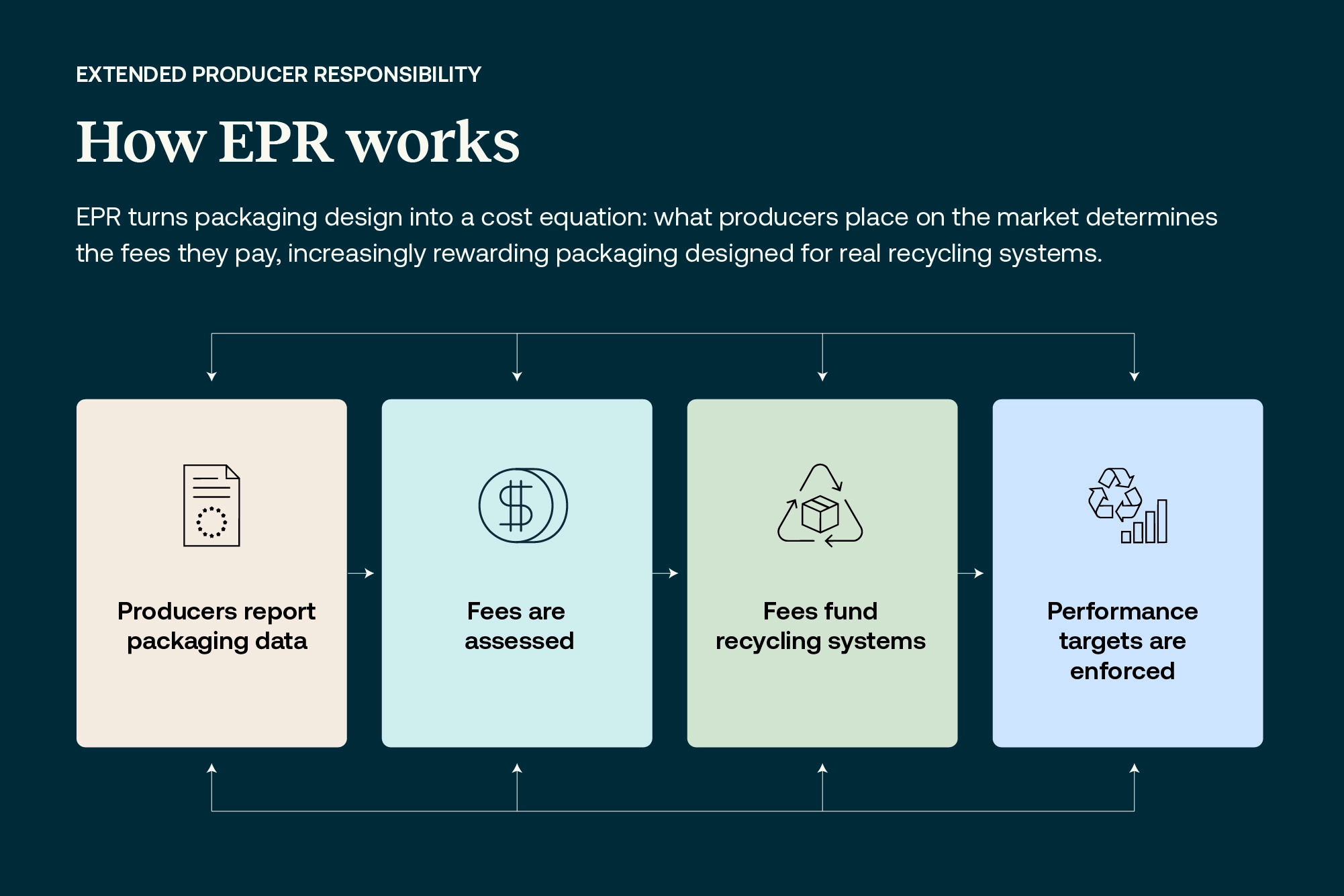
La responsabilité élargie du producteur transfère la responsabilité financière et opérationnelle des déchets d'emballages des municipalités vers les entreprises qui mettent ces emballages sur le marché. En pratique, un organisme de gestion ou un organisme de responsabilité des producteurs (ORP) perçoit des redevances auprès des producteurs en fonction du poids et du type de matériau, et, dans un nombre croissant de programmes, sur la base de l' écomodulation: des bonus pour les emballages conçus pour être recyclés, et des pénalités pour ceux qui ne le sont pas. Comme le souligne clairement le guide sur les emballages d'Amcor , la plupart des marques seront mises à contribution, et cette redevance « deviendra une partie intégrante de la structure des coûts ».
Les mécanismes varient selon les marchés, mais la tendance est claire : les redevances forfaitaires basées uniquement sur le poids laissent place à des systèmes qui récompensent les emballages monomatériaux, largement recyclables et sans éléments perturbateurs, tout en pénalisant les formats composites difficiles à trier.
Selon le Rapport sur les tendances de la REP 2026, publié par la plateforme de conformité Recyda, 2026 est l'année où plusieurs grands programmes européens dépassent la simple tarification au poids pour adopter des structures de redevances éco-modulées, où la conception et la recyclabilité des emballages influencent directement les coûts supportés par les producteurs :
Belgique (Fost Plus) a augmenté son tarif moyen pour les emballages plastiques de 9,61 % pour 2026, avec une hausse de 110,5 % pour les emballages en PSE et de 55,7 % pour les bouteilles en PE, deux augmentations directement liées à la difficulté de recyclage de ces formats.
Espagne (Ecoembes) a pris la direction opposée concernant les tarifs moyens du plastique, avec une baisse de 9,85 %, récompensant les emballages répondant à au moins deux critères d'éco-conception tout en appliquant une pénalité de 10 % sur les éléments non recyclables, les multicouches inséparables et les encres ou colles incompatibles.
Portugal a introduit l'éco-modulation pour la première fois le 1er janvier 2026, appliquant un bonus de 10 % pour les emballages conçus pour le recyclage et maintenant la pénalité de 10 % sur les composants perturbateurs introduite en 2022.
Italie (CONAI) a restructuré les redevances sur le plastique par niveau de recyclabilité entre juillet 2025 et janvier 2026, le niveau le plus difficile à recycler passant de 441 €/t à 611 €/t.
France a introduit un programme REP dédié aux emballages B2B à partir du 1er janvier 2026, ainsi qu'une prime au contenu recyclé par paliers pouvant atteindre 1 000 €/t pour les résines difficiles à recycler dans les emballages en contact avec les produits.
Aujourd'hui, les États membres de l'UE gèrent leurs propres systèmes nationaux de REP et d'éco-modulation. PPWR vise à harmoniser davantage à l'échelle de l'UE les critères d'évaluation de la recyclabilité des emballages et, à terme, à moduler les contributions REP, mais ce cadre harmonisé est encore en cours d'élaboration. D'ici le 1er janvier 2028, la Commission européenne devra établir des critères détaillés de conception en vue du recyclage, des niveaux de performance en matière de recyclabilité et le cadre associé pour la modulation des contributions financières REP. Ces exigences harmonisées en matière de recyclabilité s'appliqueront à partir de 2030. Il s'agit d'une évolution que Vela a analysée plus en détail dans « De la réglementation à la réalité : la nouvelle ère de l'emballage en Europe. »
Le nouveau système REP pour les emballages au Royaume-Uni, géré par PackUK, a délibérément dissocié la déclaration des données du coût. Le paiement des redevances a débuté fin 2025. La partie opérationnelle, à savoir l'éco-modulation basée sur la méthodologie d'évaluation de la recyclabilité (RAM), commencera à figurer sur les factures de 2026/27. Le cadre confirmé par PackUK applique des facteurs de modulation progressifs de 1,2x la première année, 1,6x la deuxième année et 2x la troisième année aux emballages classés « rouge » en termes de recyclabilité, par rapport à des tarifs de base indicatifs d'environ 415 £/t pour le plastique classé vert et 545 £/t pour le plastique classé rouge. Sur des volumes importants, cet écart se chiffre en millions. La période de transition accordée aux marques en 2025 pour corriger les formats classés rouge touche désormais à sa fin.
Les États-Unis ne disposent pas de loi fédérale sur la REP, mais 2026 sera l'année où plusieurs programmes étatiques passeront de la législation à l'application concrète. Circular Action Alliance (CAA), l'organisme de responsabilité élargie des producteurs (OREP) désormais opérationnel en Californie, au Colorado, dans le Maryland, au Minnesota, dans l'Oregon et dans l'État de Washington, a soumis le projet SB 54 plan de programme mi-2026, avant le début des obligations financières complètes en janvier 2027. L'Oregon et le Colorado ont entamé leur première année de paiement obligatoire des redevances le 1er janvier 2026. La date limite d'enregistrement pour le Maryland est fixée au 1er juillet 2026. De l'autre côté de la frontière, la Colombie-Britannique, la Nouvelle-Écosse et le Nouveau-Brunswick entrent tous dans des phases de conformité contraignantes cette année, coordonnées en partie par le réseau Circular Materials PRO. Vela s'est penché sur l'aspect le plus critique de cette transition, à savoir les règles d'étiquetage et de recyclabilité de la Californie, dans « Pourquoi les marques de vêtements repensent l'utilisation des sacs en plastique en Californie. »
Le résultat, comme le souligne le rapport Recyda, est une carte de la conformité véritablement fragmentée : une seule unité de gestion des stocks (UGS) vendue en Californie, dans l'Oregon, en Ontario et aux Pays-Bas peut être soumise à quatre structures de redevances différentes, quatre calendriers de déclaration distincts et quatre définitions différentes de ce qui est considéré comme « recyclable ».
Dans le cadre des régimes de REP, les redevances sont de plus en plus déterminées par la conception de l'emballage, et pas seulement par son poids. Les formats monomatériaux, largement recyclables, bénéficient de redevances réduites ou de bonus d'éco-modulation, tandis que les emballages multicouches et difficiles à recycler coûtent plus cher. Des normes telles que celles du CEPI deviennent également des références clés pour déterminer ce qui est considéré comme recyclable dans la pratique.
Pour les marques de vêtements et de commerce électronique qui utilisent encore systématiquement des sacs en plastique, la donne change. Il ne s'agit plus seulement d'une décision liée à la durabilité ou à l'image de marque. C'est un poste de coût qui s'accumule sur chaque marché où une marque expédie ses produits. Les formats entièrement recyclables à base de papier conçus pour être circulairesse situent structurellement du côté favorable de la plupart des cadres d'éco-modulation, car ils sont déjà monomatériaux, sans éléments perturbateurs et conçus pour les flux de récupération que ces régimes visent à encourager. Cela ne signifie pas seulement une moindre exposition au plastique. C'est aussi une moindre exposition aux structures de redevances qui sont actuellement élaborées autour de la recyclabilité.
La REP ne convergera pas vers une norme mondiale unique de sitôt. L'UE, le Royaume-Uni et l'Amérique du Nord rédigent chacun leurs propres règles, à leur propre rythme, avec leurs propres définitions de la recyclabilité. Ce qui converge, c'est l'incitation sous-jacente : les emballages qui fonctionnent au sein de systèmes de recyclage réels coûtent moins cher, ceux qui ne le font pas coûtent plus cher, et cet écart ne fera que se creuser à mesure que davantage de régimes passeront à l'éco-modulation. Les marques qui considèrent leurs spécifications d'emballage pour 2026 comme une tâche de conformité ponctuelle devront les revoir en 2027 et 2028, à un prix plus élevé. Pour découvrir comment le passage à des emballages à base de papier s'inscrit dans ce calendrier, découvrez le processus d'intégration de Vela.
Recyda : Rapport sur les tendances de la REP 2026
Amcor : Comment la responsabilité élargie du producteur impacte mes emballages
Commission européenne : Règlement sur les emballages et les déchets d'emballages (PPWR)
OCDE : Responsabilité élargie du producteur
Circular Action Alliance : À propos
Circular Action Alliance : Californie (SB 54)
Vela : De la réglementation à la réalité : la nouvelle ère de l'emballage en Europe
Vela : Pourquoi les marques de vêtements repensent leurs sacs en plastique en Californie
Vela : L'emballage évolue. Votre marque est-elle prête ?
Vela : Qu'est-ce que le cadre de recyclabilité du CEPI et pourquoi est-il important ?
Téléchargez l'étude complète et découvrez comment le choix des matériaux influence la perception, l'engagement et la valeur de la marque.
SHARE THIS ARTICLE:


Parlons de la façon dont Vela™ peut soutenir vos objectifs.


Remplissez le formulaire et l'un de nos représentants commerciaux de votre région vous contactera dans les 72 heures.